


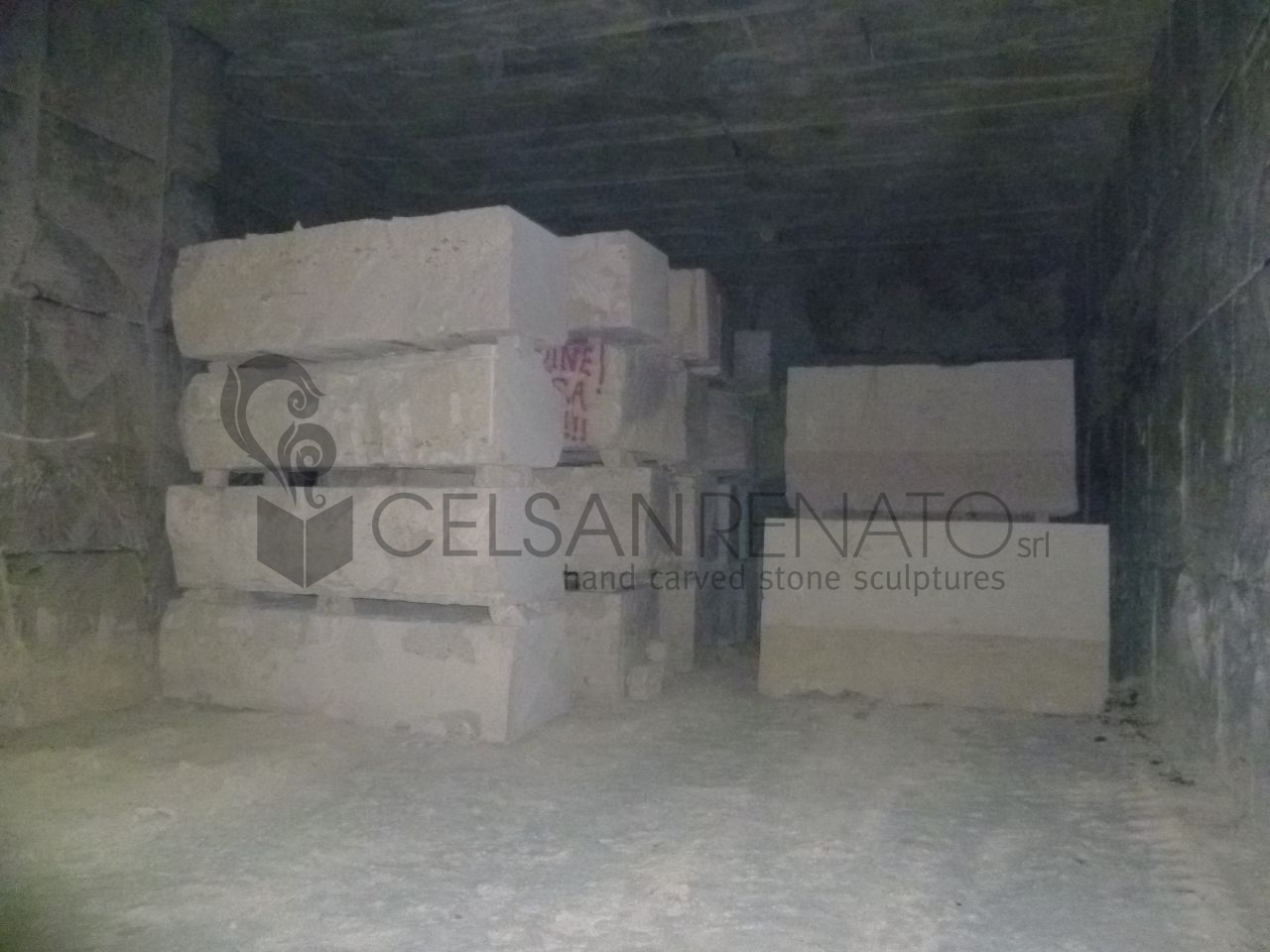
If we had a powerful time machine, we could try to leap back approximately 40 million years, to a geological era called the Oligocene. In the area that today corresponds to Veneto, we would find ourselves facing a shallow sea, enveloped in a tropical climate. On the horizon, in the present-day area stretching from the Berici Hills to Lessinia, we would see a flourishing coral reef delimiting a placid lagoon, where the remains of a species of algae, nullipores, began to deposit. It is in this prehistoric “womb” that the history of Vicenza stone begins.
The sedimentation of nullipore remains is the phenomenon underlying the formation of that white, soft stone that is now known worldwide as Vicenza Stone. The numerous archaeological finds that are visible today in Vicenza at the Archaeological Museum of Santa Corona, in Este at the National Museum, and at the Civic Museum at the Eremitani in Padua, prove that knowledge of this stone was already present among the Paleo-Venetic populations and later in Roman times.
In the Middle Ages, among the various artisan guilds present in Vicenza, there was that of the masons, which included a particular specialization, that of the “taiapiere” (stone cutters). The statute regulating this guild dates back to 1402. We can say that Vicenza stone has accompanied, over the centuries, the social and economic development of the entire territory at the foot of the Berici Hills. A presence that we could capture in some particularly significant images.
In the rural Vicenza of the late 19th and early 20th centuries, the winter months were dedicated to the priare—as the Vicenza stone quarries were called—and it was easy to come across carts pulled by several pairs of oxen carrying blocks of brilliant white stone, extracted with chisel blows and “pendole” (wedges), toward the workshops.
Those white blocks of stone had not left even a great Vicenza architect like Palladio indifferent, who used it in his projects for the creation of pilasters, fireplace surrounds for windows and doors, and for decorations. But walking through the countryside at the foot of the Berici Hills, one could notice white streaks characterizing even the houses of farmers, and then fountains, fireplaces, and floors.
A history, that of this area of Vicenza, steeped in the white of its stone and capable of developing a craftsmanship now known throughout the world, whose products are highly sought after